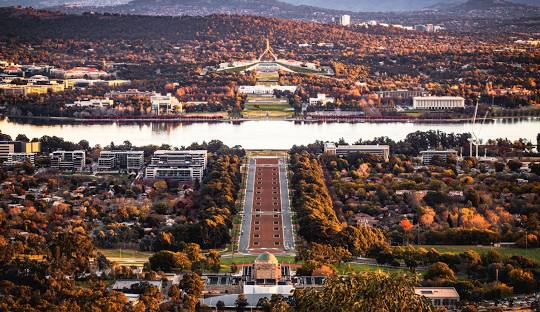
Canberra: The Heart of Australia’s Nation and Its Evolving Capital City
Posted by on
Canberra, the capital city of Australia, is located within the Australian Capital Territory (ACT) at the northern tip of the Australian Alps. Founded on 12 March 1913, Canberra was purposefully designed to serve as the seat of government following the federation of the Australian colonies. Today, it remains the political and administrative center of the nation, hosting the Australian Parliament House, High Court, and numerous national institutions such as the National Gallery of Australia, National Library, and Australian War Memorial.
As of June 2024, Canberra’s estimated population stands at 473,855, making it the eighth-largest city in Australia and the largest located inland. The city spans an area of 814.2 square kilometers and sits at an elevation of 578 meters above sea level. Canberra is known for its balanced urban design, which integrates wide open spaces, green corridors, and man-made lakes with striking examples of modern and contemporary architecture.
Geographically, the city lies approximately 285 kilometers southwest of Sydney and 669 kilometers northeast of Melbourne, offering easy access to both major cities. Canberra experiences a temperate climate, with a mean maximum temperature of 20.4°C and a mean minimum of 7.0°C, alongside an average annual rainfall of 579.5 millimeters.
Governed by both territory electorates (including Brindabella, Ginninderra, Kurrajong, Murrumbidgee, and Yerrabi) and federal divisions (Canberra, Fenner, and Bean), the city plays a crucial role in Australia’s democratic system. Beyond politics, Canberra has evolved into a vibrant hub for education, culture, and innovation, supported by leading institutions such as the Australian National University (ANU).
Known by its Indigenous Ngunawal name “Kanbarra,” meaning “meeting place,” Canberra continues to embody its foundational vision—a place where nature, culture, and governance intersect. With its growing population, sustainable urban planning, and national significance, Canberra stands not only as the capital of Australia but also as a symbol of the country’s unity and progress.